
Connectivity is becoming Europe’s new tourism bottleneck

Why tourism growth in Iberia increasingly depends on access resilience rather than demand alone

European tourism continues to report strong recovery indicators. Passenger numbers have returned across major hubs, hotel performance remains resilient across multiple Mediterranean markets, and international arrivals continue to reinforce optimistic narratives around demand growth. Yet beneath these numbers, a more structural tension is becoming increasingly visible: growth is no longer constrained primarily by demand. It is constrained by access.
This distinction matters more than many tourism discussions currently acknowledge. For years, the sector operated under the assumption that demand generation represented the central challenge. Destination marketing, route stimulation, branding strategies and international promotion dominated both institutional and commercial agendas. Connectivity was often treated as operational support infrastructure rather than as a strategic determinant of tourism viability itself.
That logic is becoming increasingly fragile. Across Europe, tourism performance is now more directly exposed to airport saturation, aircraft availability constraints, fuel volatility, geopolitical instability, airspace disruption and growing pressure on transport infrastructure. Accessibility is no longer simply a mobility issue. It is becoming an economic infrastructure issue.
This shift is particularly relevant for Iberia. Portugal remains structurally dependent on air connectivity for international tourism flows. Unlike more centrally connected European markets, the country operates from a peripheral geographical position with high exposure to aviation continuity and route sustainability. Spain benefits from greater internal scale and stronger rail integration, yet also faces increasing pressure around airport capacity concentration and territorial asymmetries between primary and secondary regions.
The result is a tourism ecosystem where demand may exist, but access cannot always scale at the same pace.

A destination can generate international interest while simultaneously lacking the operational conditions required to sustain predictable growth. Airlines increasingly prioritise route profitability, fleet efficiency and operational resilience over expansion narratives alone. Airports face infrastructure limitations that cannot be solved through short-term promotion strategies. Hospitality performance becomes progressively linked not only to demand levels, but to the stability and predictability of connectivity systems themselves.
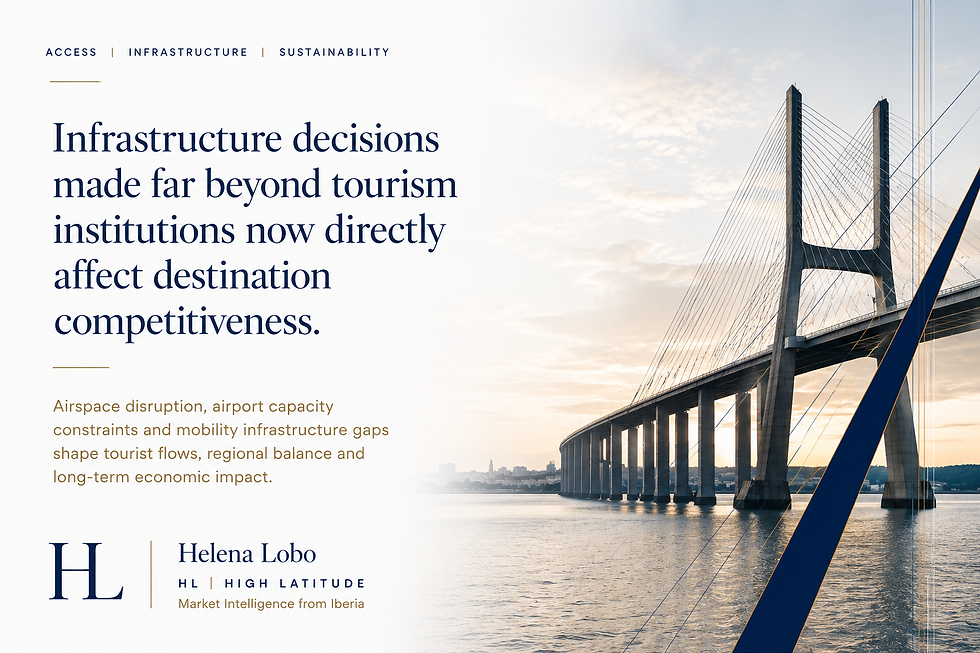
In this environment, accessibility becomes inseparable from commercial viability. This is already visible across multiple layers of the industry. Secondary destinations compete not only for visitors, but for operational relevance inside airline network planning. Route development is increasingly influenced by broader geopolitical and fuel exposure considerations. Infrastructure decisions made far beyond tourism institutions now directly affect hospitality performance, destination competitiveness and regional economic balance.
At the same time, the relationship between tourism and mobility is becoming more interconnected across systems. High-speed rail, cross-border accessibility, intermodal integration and regional transport coordination are no longer peripheral discussions. They increasingly influence tourism concentration patterns, investment attractiveness and long-term territorial sustainability.
The industry often continues to celebrate growth figures without fully examining the infrastructure logic required to sustain them. That may become one of the central strategic blind spots of the next decade. For peripheral and aviation-dependent markets such as Portugal, connectivity resilience is no longer a secondary operational concern. It is becoming part of the core economic foundation supporting tourism performance itself.
Growth still matters. But growth without resilient access systems becomes progressively more fragile. And in tourism, fragility rarely appears immediately in demand statistics. It appears first in operational pressure, infrastructure strain, route instability and declining predictability across the mobility ecosystem.
Accessibility is no longer simply supporting tourism growth. It is increasingly defining its limits.